
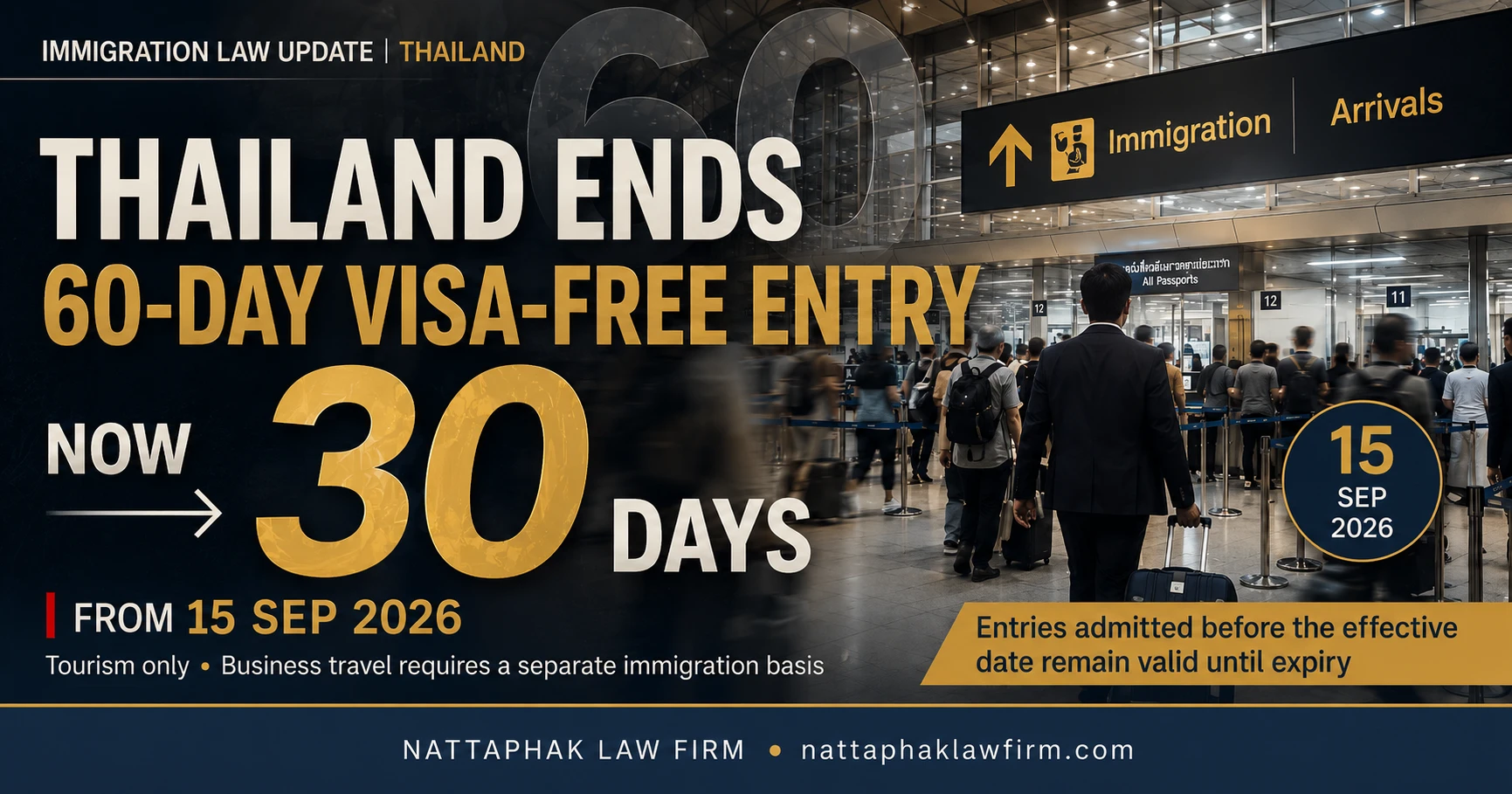
From 15 September 2026, Thailand’s 60-day visa-exemption scheme for nationals of 93 countries and territories will cease to apply. A new Ministry of Interior framework replaces it with a 30-day visa exemption for ordinary passport holders from 60 countries and territories, and the new exemption is expressly limited to entry for tourism. The final framework also introduces a 15-day tourism exemption for two countries and Visa on Arrival for three countries.
The change is more than a reduction from 60 days to 30 days. Under the former scheme, the 60-day exemption expressly covered tourism, business engagements and urgent or ad-hoc work. The new 30-day unilateral exemption refers to tourism only. A foreign executive entering Thailand for meetings, negotiations, project supervision or other business activity therefore needs an immigration basis that supports the actual purpose of the visit rather than relying on the new tourism exemption merely because the passport appears on the 60-jurisdiction list.
Key Takeaways
- The new regime takes effect on 15 September 2026.
- The former 60-day exemption for 93 countries and territories ends.
- The principal new exemption is 30 days for tourism for 60 countries and territories.
- Travellers admitted before 15 September 2026 under the former 60-day scheme retain the period already granted to them.
- China, Hong Kong and Macao do not rely on the new 60-jurisdiction tourism list; they have separate 30-day bilateral ordinary-passport exemptions.
- Japan is on the new 30-day tourism list and also has a separately published temporary exemption for short-term Japanese business travellers through 31 December 2026.
- Entry through a land-border immigration checkpoint under the new 30-day scheme is limited to twice per calendar year, subject to specified exceptions.
What changes on 15 September 2026?
The final 2026 framework is structured as follows:
| Entry arrangement | Jurisdictions | Period | Scope |
|---|---|---|---|
| Visa Exemption | 60 countries/territories | 30 days | Tourism |
| Visa Exemption | Seychelles and Mauritius | 15 days | Tourism |
| Visa on Arrival | Azerbaijan, Belarus and Serbia | Subject to VoA rules | Entry through designated immigration checkpoints |
| Bilateral Visa Exemption | Separate treaty jurisdictions | 14, 30 or 90 days | Governed by the applicable bilateral arrangement |
The final numbers differ from the figures contained in the May 2026 policy announcement, which referred to 54 jurisdictions under the 30-day scheme, three under the 15-day scheme and four under Visa on Arrival. The enacted measures and the Department of Consular Affairs’ final summary now establish the 60 / 2 / 3 structure.
The new 30-day exemption is for tourism, not the former business-travel regime
The former 60-day scheme, effective from 15 July 2024, allowed nationals of 93 countries and territories to enter without a visa for tourism, business engagements or urgent/ad-hoc work for up to 60 days.
The 2026 notification uses materially narrower language. It prescribes the listed nationalities and territories for temporary entry for tourism and grants a stay of no more than 30 days.
Accordingly, the fact that a passport remains eligible for 30-day visa-exempt entry does not preserve the former business-purpose exemption. For a business visit, the traveller needs a separate legal basis that covers that purpose, including a Non-Immigrant Visa “B” where applicable, a bilateral exemption that permits the visit, or a country-specific exemption. The Department of Consular Affairs identifies Non-Immigrant “B” as the visa category for business contact, carrying on business and employment.
Visa status and permission to work remain separate legal questions. An immigration basis permitting entry for business does not itself grant unrestricted authority to work in Thailand.
Why the effective date is 15 September: “นับแต่” is not the same as starting the count on the next day
The notification was announced on 31 August 2026 and states that it takes effect:
“เมื่อพ้นกำหนดสิบห้าวันนับแต่วันประกาศในราชกิจจานุเบกษาเป็นต้นไป”
The operative phrase is “นับแต่วันประกาศ” — counting from the date of publication. It is not a formulation that begins the count on the following day.
The Council of State has addressed the same commencement formula in Opinion No. 290/2543. Where legislation takes effect after a prescribed number of days “นับแต่วันประกาศในราชกิจจานุเบกษา”, the publication date is counted as day one. The statutory commencement provision controls rather than the ordinary civil-law method of calculating a period.
The count for the 2026 visa notification is therefore:
| Date | Legal count |
|---|---|
| 31 August 2026 | Day 1 |
| 1 September 2026 | Day 2 |
| 14 September 2026 | Day 15 |
| 15 September 2026 | Fifteen days have elapsed; new regime takes effect |
This is also the effective date expressly confirmed by the Department of Consular Affairs on 1 September 2026.
Travellers entering before 15 September retain the 60-day admission already granted
The revised rules do not shorten an existing permission to stay.
The Department of Consular Affairs confirmed during the 2026 revision process that foreigners already in Thailand under the existing visa-exemption schemes, and travellers entering Thailand before the revised measures take effect, retain their permitted stay until its expiry.
For example, a national who remains eligible under the former 93-jurisdiction scheme and enters Thailand on 14 September 2026 can be admitted under the existing 60-day regime. If immigration grants a 60-day stay on entry, the commencement of the new regime on 15 September does not reduce that admission to 30 days.
The new rules govern a subsequent entry made from 15 September 2026 onward.
Major investment jurisdictions do not all use the same visa-exemption basis
This distinction has direct relevance to multinational groups operating in Thailand. BOI’s Q1 2026 FDI statistics ranked Singapore, the United Kingdom, Japan, China, Hong Kong, Taiwan, Indonesia, the United States, the Netherlands and Spain as the top ten sources of BOI investment applications by value. Singapore alone accounted for THB 837.941 billion of applications during the quarter.
Applying the final visa framework to those investor jurisdictions produces different results:
| BOI Q1 2026 Rank | Source jurisdiction | Investment applications (THB million) | Entry position from 15 Sept 2026 |
|---|---|---|---|
| 1 | Singapore | 837,941 | 30-day unilateral exemption — tourism |
| 2 | United Kingdom | 47,150 | 30-day unilateral exemption — tourism |
| 3 | Japan | 22,593 | 30-day unilateral tourism exemption; separate Japanese short-term business exemption also published through 31 Dec 2026 |
| 4 | China | 17,327 | 30-day bilateral ordinary-passport exemption |
| 5 | Hong Kong | 16,097 | 30-day bilateral ordinary-passport exemption |
| 6 | Taiwan | 14,679 | 30-day unilateral exemption — tourism |
| 7 | Indonesia | 1,374 | 30-day unilateral exemption — tourism; land-border frequency exception |
| 8 | United States | 1,282 | 30-day unilateral exemption — tourism |
| 9 | Netherlands | 915 | 30-day unilateral exemption — tourism |
| 10 | Spain | 870 | 30-day unilateral exemption — tourism |
The BOI ranking above is the official Q1 2026 ranking by value of foreign investment applications. The visa classification reflects the final Ministry of Interior scheme and the Department of Consular Affairs’ 1 September 2026 bilateral and visa-exemption summary.
Singapore
Singapore ranks first in BOI’s Q1 2026 FDI application statistics and remains in the new 60-jurisdiction 30-day exemption list. The legal basis in that list is tourism. A Singaporean executive entering for a corporate purpose therefore needs an entry basis supporting the business activity rather than treating the tourism exemption as a continuation of the former 60-day business-engagement regime.
Singapore also receives special treatment for land-border entry. The general limit of two visa-exempt land-border entries per calendar year does not apply to nationals of Singapore, Malaysia, Brunei or Indonesia, together with any other nationality subsequently designated by the Minister.
Japan
Japan ranks third by value of BOI investment applications in Q1 2026 and is included in the new 30-day tourism-exemption list.
Japan also has a separate temporary measure specifically for short-term business travellers. The Ministry of Foreign Affairs states that Japanese ordinary-passport holders entering Thailand for short-term business engagements are exempt from visa requirements for stays not exceeding 30 days from 1 January 2024 to 31 December 2026. The traveller must be ready to present evidence of the business engagement, such as an appointment confirmation, invitation letter or certification from a relevant organisation.
The new 30-day tourism exemption and the Japan-specific business measure therefore involve different legal purposes. Corporate travel documentation needs to identify the basis actually relied upon.
China
China ranked fourth in BOI’s Q1 2026 investment-application ranking. Chinese ordinary-passport holders are not dependent on the new 60-jurisdiction tourism list because Thailand and China have a bilateral visa-exemption agreement providing stays of up to 30 days, subject to a cumulative maximum of 90 days within any 180-day period.
The Thailand-China agreement excludes residence, employment, study, media activities and other activities requiring prior approval. The Ministry of Foreign Affairs expressly described the agreement as facilitating both tourism and business contacts. A business visit and employment therefore remain legally distinct.
Hong Kong
Hong Kong ranked fifth in BOI’s Q1 2026 investment-application statistics. From 15 September 2026, Hong Kong remains within Thailand’s 30-day bilateral ordinary-passport exemption, rather than the new 60-jurisdiction tourism exemption.
This distinction matters for corporate mobility because the legal source of the exemption is different. The bilateral arrangement governs entry by Hong Kong passport holders; the tourism-only wording of the new unilateral 60-jurisdiction notification is not the source of their 30-day visa exemption.
Macao
Macao is not part of BOI’s Q1 2026 top-ten investment-source table, but it is relevant to regional corporate travel and group structures. Like China and Hong Kong, Macao is outside the new 60-jurisdiction tourism list because it has a separate 30-day bilateral ordinary-passport exemption with Thailand.
The Thailand-Macao agreement provides visa-free entry, exit or transit for holders of valid passports for a stay not exceeding 30 days. The bilateral route therefore remains distinct from the new tourism-only exemption.
Taiwan, the United Kingdom, the United States, the Netherlands and Spain
Taiwan, the United Kingdom, the United States, the Netherlands and Spain all appear among BOI’s Q1 2026 top-ten FDI application sources and all fall within the new 30-day unilateral visa-exemption list. The exemption provided by the new notification is for tourism.
A visit for meetings, negotiations, due diligence, management activities or other corporate work therefore requires analysis of the actual purpose of entry and the immigration category supporting it.
Indonesia
Indonesia also appears in BOI’s Q1 2026 top ten and remains in the 30-day tourism-exemption list. Its nationals are expressly excluded from the twice-per-calendar-year limit for visa-exempt entry through land-border checkpoints, together with nationals of Malaysia, Brunei and Singapore.
China, Hong Kong and Macao are not “missing” from Thailand’s visa-free system
A passport not appearing in the new 60-jurisdiction list does not necessarily require a visa.
The Department of Consular Affairs’ final 2026 summary identifies separate ordinary-passport bilateral exemptions of 30 days for China, Kazakhstan, Hong Kong, Laos, Macao, Mongolia, Russia, Timor-Leste and Vietnam. Cambodia and Myanmar fall under 14-day bilateral arrangements, while Argentina, Brazil, Chile, Peru and Korea fall under 90-day arrangements.
For corporate travel, nationality alone therefore does not answer the immigration question. The relevant sequence is: identify the passport, identify the purpose of entry, identify the legal basis for exemption or visa, and then examine work-authorisation requirements separately.
Land-border entries are limited to twice per calendar year
For nationals using the new 30-day tourism exemption through an immigration checkpoint or border checkpoint adjoining Thailand’s land frontier, entry under that exemption is limited to two times per calendar year.
The notification expressly excludes nationals of Malaysia, Brunei Darussalam, Indonesia and Singapore from that two-entry limit. The Minister also retains authority to prescribe additional nationalities for different treatment.
The rule is expressed per calendar year, not as a rolling twelve-month period.
Corporate travel policies need to distinguish tourism, business contact and work
The former 60-day regime allowed corporate mobility teams to rely on one broad exemption for many short trips from the 93 eligible jurisdictions. That framework ends on 15 September 2026.
For travel from that date, the entry analysis needs to separate:
- tourism under the new 30-day or 15-day exemption;
- entry under a bilateral visa-exemption agreement;
- a country-specific business exemption, including the Japanese short-term business measure;
- Non-Immigrant Visa “B” or another appropriate visa category;
- activities constituting work under Thai foreign-worker legislation;
- land-border frequency restrictions; and
- the duration already granted on a previous admission.
A corporate invitation letter does not change a tourism exemption into a business-entry permission. The legal basis must match the actual purpose of the visit.
Frequently Asked Questions
When does Thailand’s 60-day visa exemption end?
The new framework takes effect on 15 September 2026. From that date, the former 60-day scheme for 93 countries and territories no longer governs new entries.
If a traveller enters Thailand on 14 September 2026, does the stay fall from 60 days to 30 days on 15 September?
No. If the traveller enters under the former 60-day exemption before the new regime takes effect and immigration grants a 60-day period of stay, that permission remains valid until its recorded expiry date.
Does the new 30-day exemption cover a business meeting?
The new unilateral 30-day exemption is drafted for tourism. A business visitor needs an immigration basis that supports the business purpose, such as an applicable bilateral or country-specific exemption or the appropriate visa category.
Are China, Hong Kong and Macao excluded from visa-free entry?
No. Each has a separate 30-day bilateral ordinary-passport exemption with Thailand. They do not rely on the new 60-jurisdiction tourism list.
What applies to Japanese short-term business travellers?
Japan is on the new 30-day tourism-exemption list. Separately, the Ministry of Foreign Affairs publishes a temporary 30-day exemption for Japanese ordinary-passport holders entering for short-term business engagements through 31 December 2026, with supporting business documentation required at entry.
How many times can a traveller enter Thailand visa-free through a land border?
Under the new 30-day unilateral exemption, the limit is two land-border entries per calendar year. The limit does not apply to nationals of Malaysia, Brunei, Indonesia and Singapore, or other nationalities subsequently prescribed by the Minister.