
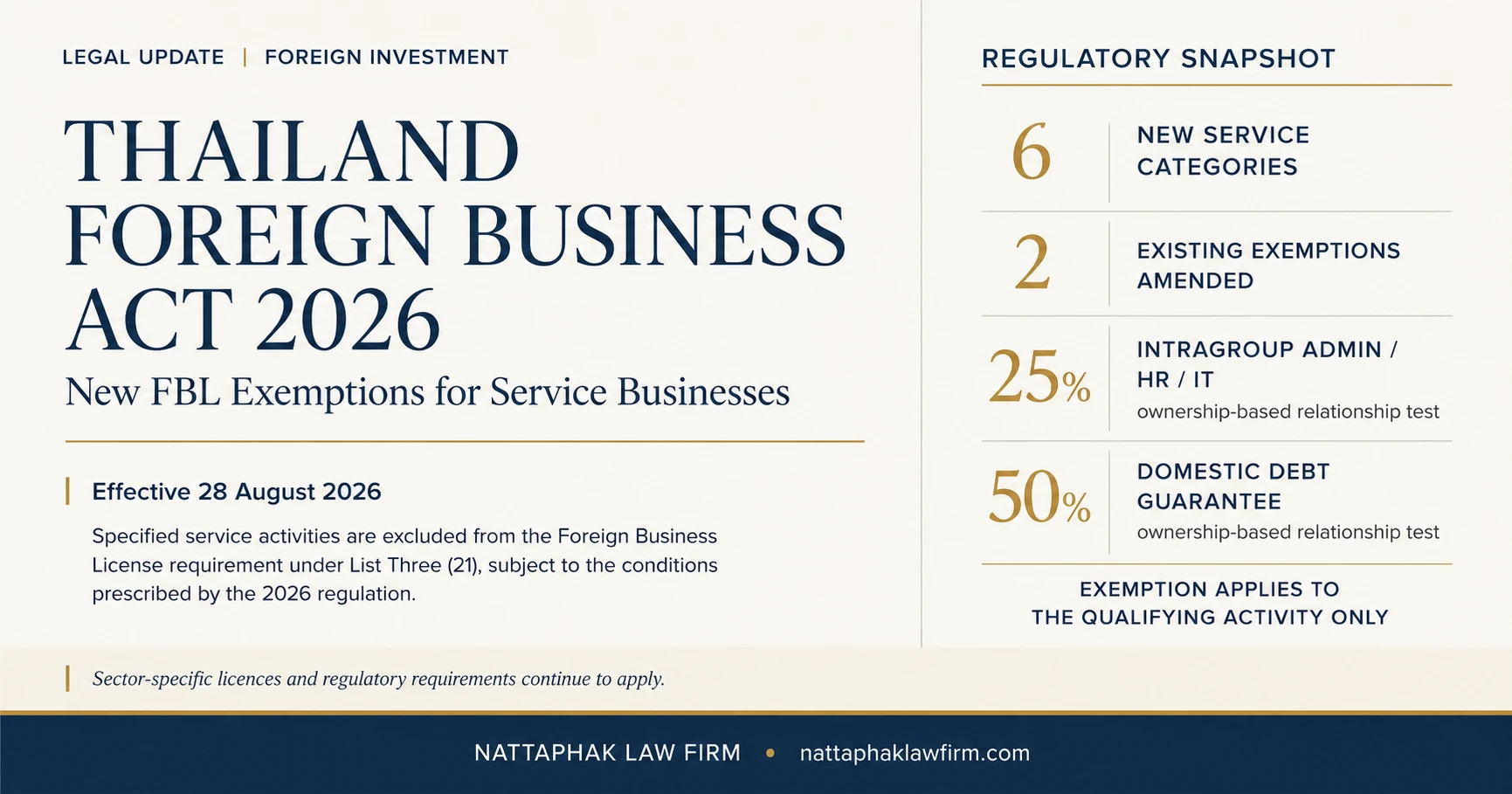
On 28 August 2026, the Ministerial Regulation Prescribing Service Businesses Not Requiring Permission for Foreign Business Operations (No. 5), B.E. 2569 (2026) (the “Regulation”) was published in the Royal Gazette, Volume 143, Part 51 A. The Regulation expands the service businesses excluded from List Three (21) of the Foreign Business Act B.E. 2542 (1999) (the “FBA”). The Regulation took effect upon publication.
From 28 August 2026, a foreigner carrying on a qualifying service covered by the Regulation does not require a Foreign Business License (FBL) for that activity under List Three (21). The Regulation adds six new exempt service categories and amends the existing exemptions for securities and derivatives businesses. The exemption is activity-specific: it does not remove FBA restrictions from the company’s other businesses and does not replace licences or approvals required under sector-specific legislation.
Key Takeaways
- Six new service categories have been added to the List Three (21) exemptions, while the existing securities and derivatives exemptions have also been amended.
- Qualifying intragroup administrative, human resources and IT services now fall outside the FBL requirement under List Three (21).
- The ownership-based relationship tests for those shared services use a 25% threshold.
- Domestic intragroup debt guarantees use a higher 50% threshold for the corresponding ownership-based tests.
- Treasury centres and qualifying Type 1 telecommunications businesses no longer require an FBL under List Three (21), but their sector-specific regulatory regimes continue to apply.
- The exemption follows the specific activity. It does not exempt every activity conducted by the same foreign-owned company.
- Existing FBL, Foreign Business Certificate (FBC), BOI and sector-licensing structures need to be reviewed activity by activity before any regulatory change is made.
What changed under Thailand’s Foreign Business Act on 28 August 2026?
The FBA restricts specified businesses carried on by a “foreigner” as defined in section 4. List Three contains businesses in which Thai nationals were regarded as not yet ready to compete with foreigners when the FBA was enacted. List Three (21) operates as the residual category for “other service businesses,” subject to an express exception for service businesses prescribed by ministerial regulation.
The Regulation uses that exception to remove additional specified services from List Three (21). Where the actual service and all conditions in the relevant provision are satisfied, the activity falls outside the List Three (21) FBL requirement.
This mechanism is important for foreign-owned companies in Thailand because a single company frequently carries on several different services. An exemption for one service does not extend to the company’s other services. An intercompany agreement covering IT support, accounting, legal coordination, procurement and consultancy must therefore be classified service by service; the exemption for qualifying IT management does not convert the entire agreement into an exempt business.
Which businesses no longer require an FBL under the 2026 Regulation?
The enacted Regulation first expands the existing securities exemption, then replaces the existing derivatives provision, and then inserts six new service categories as items (13) to (18). When securities and derivatives are treated separately, the Regulation affects eight principal business areas.
| Business activity | Change under the 2026 Regulation | Principal condition |
|---|---|---|
| 1. Securities businesses | Existing exemption expanded to include lending for the purchase of securities and securities repurchase transactions. | The activity must fall within the applicable securities-law framework. |
| 2. Derivatives businesses | Existing provision revised for specified dealers, advisers, fund managers and prescribed derivatives transactions. | The transaction must fall within the scope specified in the Regulation. |
| 3. Type 1 telecommunications services | New item (13). | The operator must fall within the specified Type 1 telecommunications licensing framework and have no telecommunications network of its own. |
| 4. Treasury centre business | New item (14). | The business operates under Thailand’s exchange-control framework. |
| 5. Intragroup administrative, HR and IT management services | New item (15). | The entities must satisfy one of the prescribed relationship tests. |
| 6. Domestic debt guarantees between related entities | New item (16). | The debt must be domestic and the entities must satisfy one of the prescribed relationship tests. |
| 7. Leasing part of premises for specified equipment | New item (17). | The space must be used for specified financial-service electronic equipment or automated vending/service machines for employees. |
| 8. Petroleum drilling services | New item (18). | The contractor must contract directly with a prescribed counterparty under petroleum law. |
The number used in a news headline is therefore less important than the legal provision relied upon. For compliance purposes, the company must identify the exact paragraph that covers the activity and establish that every condition in that paragraph is satisfied.
Do foreign-owned companies still need an FBL for intragroup HR and IT services in Thailand?
No FBL is required under List Three (21) for administrative, human resources or information technology management services that fall within item (15) and are provided between juristic persons satisfying one of the prescribed relationship tests.
This is one of the most commercially significant changes for multinational groups using Thailand as a shared-services location. The Regulation does not rely on broad commercial expressions such as “affiliate” or “group company.” It prescribes specific ownership and management relationships that determine whether the exemption applies.
The entities satisfy item (15) where any one of the following tests is met:
- More than half of the shareholders or partners of one juristic person are also more than half of the shareholders or partners of the other juristic person;
- A shareholder or partner holding at least 25% of the capital of one juristic person also holds at least 25% of the capital of the other juristic person;
- One juristic person holds at least 25% of the capital of the other juristic person; or
- More than half of the directors or partners with management authority of one juristic person are also directors or partners with management authority of the other juristic person.
The Regulation uses alternative tests. Satisfying one prescribed relationship is sufficient; the entities do not have to satisfy every test. The 25% threshold applies specifically to the ownership-based tests in item (15), not as a general statutory definition of an affiliate under Thai law.
This distinction has direct consequences for corporate documentation. A group structure chart describing two companies as affiliates does not itself establish the exemption. The supporting analysis needs to identify the relevant shareholder, ownership percentage or common management relationship and match that fact to the applicable limb of item (15).
The service scope matters as much as the shareholding structure
Item (15) covers management services relating to administrative work, human resources and information technology. It does not use the broader expression “management services” without qualification.
A multinational group therefore cannot treat every service charged under a Management Services Agreement or Shared Services Agreement as exempt. Where an agreement includes HR administration, IT support, accounting, tax assistance, legal services, procurement, marketing, engineering or business consultancy, each service needs its own FBA classification.
This distinction also affects transfer-pricing and tax documentation. The service agreement, invoices, allocation methodology, cost base and supporting records need to identify the functions actually performed and the consideration charged for those functions. The new FBA exemption does not alter the application of Thai transfer-pricing rules, VAT, withholding tax, personal data protection or employment law.
What is the 50% threshold for domestic intragroup guarantees?
Item (16) exempts services involving guarantees of debt within Thailand between juristic persons satisfying one of the prescribed relationships. The structure resembles item (15), but the corresponding capital-based tests use a 50% threshold instead of 25%.
| Relationship test | Item (15): Admin / HR / IT | Item (16): Domestic debt guarantee |
|---|---|---|
| Common shareholder or partner — ownership-based test | At least 25% in each entity | At least 50% in each entity |
| One entity holds capital in the other | At least 25% | At least 50% |
| Common shareholders / partners by number | More than half | More than half |
| Common persons with management authority | More than half | More than half |
The distinction produces a different result even within the same corporate group. If the same shareholder holds 30% of Company A and 30% of Company B, the 25% ownership-based test under item (15) is satisfied. The same 30% interests do not satisfy the corresponding 50% ownership-based test under item (16). Another prescribed relationship test must therefore be established before the domestic guarantee exemption applies.
Item (16) is expressly confined to guarantees of debt within Thailand. It does not create a general FBA exemption for cross-border guarantees, offshore financing arrangements, upstream guarantees, downstream guarantees or other forms of credit support. Those structures require separate analysis based on the actual obligation and transaction.
Why the 25% and 50% distinction matters for group restructuring
For multinational groups, the ownership percentage is no longer relevant only to the question of whether the Thai company itself is a “foreigner” under the FBA. The new Regulation introduces separate relationship thresholds for specific intragroup exemptions.
A group can therefore have sufficient common ownership for item (15) but insufficient common ownership for the corresponding capital test in item (16). A corporate restructuring, share transfer or dilution of an existing shareholder can also change whether the exemption remains available.
For that reason, reliance on items (15) and (16) should be documented by reference to the shareholder register and the current group structure rather than established once and then treated as permanent.
Does a Treasury Centre in Thailand still require an FBL?
A treasury centre falling within item (14) no longer requires an FBL under List Three (21) for the qualifying treasury centre business. The activity remains subject to Thailand’s exchange-control framework and the regulatory requirements governing treasury centre operations.
The exemption therefore removes an overlapping FBA layer; it does not convert the treasury centre into an unregulated financial business. The Bank of Thailand and exchange-control framework remain relevant to the establishment and operation of the treasury centre.
This reflects the policy rationale behind part of the 2026 reform. The Thai Government expressly clarified during the legislative process that the measures were not intended to permit foreigners to carry on regulated activities without supervision. The purpose was to reduce overlapping approval requirements where specific legislation and specialised regulators already govern the relevant business.
Does the new FBA exemption cover all telecommunications businesses?
No. Item (13) is tied to a specific category of telecommunications business. It covers the qualifying Type 1 telecommunications business described in the Regulation, including the requirement that the operator does not have its own telecommunications network.
A telecommunications operator relying on item (13) remains subject to telecommunications licensing and the operating requirements imposed under the telecommunications regulatory framework. The Regulation removes the List Three (21) FBL requirement for the qualifying service; it does not replace the telecommunications licence.
Leasing part of company premises is a narrow exemption
Item (17) covers the leasing of part of premises for the installation of electronic equipment used to provide financial services and automated machines selling goods or services for the service and convenience of company employees.
The provision does not create a general exemption for a foreign-owned company to operate a commercial property-leasing business. The purpose of the space, the specified equipment and the employee-service element form part of the statutory scope of the exemption.
A lease falling outside that description needs a separate FBA classification.
Petroleum drilling services require a direct contractual relationship
Item (18) covers petroleum drilling services where the contractor has entered into a direct contract with a concessionaire, production-sharing contractor or service contractor under the law governing petroleum.
The direct contractual relationship is part of the exemption. A lower-tier subcontractor does not fall within item (18) solely because its services ultimately support a petroleum project. The relevant contractual chain has to match the wording of the Regulation.
What changed for securities and derivatives businesses?
The Regulation does not merely add new service categories. It also modifies existing exemptions for capital-market activities.
For securities businesses, the Regulation expands the existing exemption to include lending for the purchase of securities and securities repurchase agreement transactions. For derivatives businesses, the previous provision is replaced with an expanded exemption covering specified dealer, adviser, fund-management and prescribed derivatives activities.
A separate ministerial regulation published on 28 August 2026 addresses specified brokerage or agency businesses under List Three (11)(d), including specified derivatives agency activities. The two regulations operate under different parts of List Three and should not be combined into a single legal exemption.
Does an FBL exemption remove other Thai licence requirements?
No. An exemption under the Regulation removes the FBL requirement arising from List Three (21) for the qualifying activity. It does not disapply another statute governing the same business.
| Activity | FBA position | Separate regulatory matters that remain |
|---|---|---|
| Type 1 telecommunications | No FBL under List Three (21) within the prescribed scope | Telecommunications licence and operating conditions |
| Treasury centre | No FBL under List Three (21) | Exchange-control and Bank of Thailand requirements |
| Securities / derivatives | No FBL within the prescribed scope | Applicable securities and derivatives regulation |
| Administrative / HR / IT services | No FBL if item (15) is satisfied | Relationship test, tax, transfer pricing, VAT/WHT, PDPA, employment and contractual compliance |
| Domestic debt guarantee | No FBL if item (16) is satisfied | Domestic nature of the debt, qualifying relationship and other financial/regulatory requirements |
| Petroleum drilling | No FBL if item (18) is satisfied | Petroleum-law requirements and direct contractual relationship |
The legal distinction can be stated simply: an FBL exemption is not a regulatory exemption. It removes one FBA licensing requirement. Every other law applicable to the activity continues to apply. This was also the position expressly communicated by the Thai Government when responding to concerns that the reform amounted to unrestricted foreign-business liberalisation.
What happens to an existing Foreign Business License or Foreign Business Certificate?
A foreign-owned company already operating under an FBL or Foreign Business Certificate (FBC) should review its activities individually before changing its existing regulatory structure.
A single FBL or FBC can relate to several business activities. The Regulation excludes only the qualifying activities from List Three (21). Another activity carried on by the same company can remain restricted under the FBA or continue to depend on a different statutory basis.
The same approach applies to companies operating under Board of Investment promotion, treaty rights or sector-specific statutory permissions. The new Regulation does not amend the conditions attached to a BOI promotion certificate or remove the legal basis required for an activity falling outside the new exemptions.
The correct exercise is therefore an activity-by-activity regulatory mapping:
- identify the actual service;
- identify whether the service falls within the new Regulation;
- identify the relationship test or other conditions supporting the exemption;
- identify any remaining FBA restriction;
- identify any FBL, FBC, BOI or treaty basis currently relied upon; and
- identify the sector-specific licences that continue to apply.
Compliance checklist for foreign-owned companies in Thailand
Foreign-owned companies affected by the Regulation should review the following items before relying on an exemption:
1. Confirm the entity’s FBA status. Determine whether the relevant entity is a “foreigner” under section 4 of the FBA.
2. Map the actual business activities. Separate each service performed in practice. Do not rely only on registered objectives or a broad contractual description such as “management services.”
3. Identify the precise exemption. Link each qualifying service to the relevant item of the Regulation.
4. Establish the relationship test. For items (15) and (16), identify the exact ownership, shareholder or management relationship relied upon and retain documentary evidence supporting it.
5. Apply 25% and 50% to the correct provisions. The two thresholds are not interchangeable.
6. Review other licences and approvals. FBA exemption does not replace telecommunications, financial, capital-market, petroleum or other sector-specific regulation.
7. Align the contracts and invoices. The contractual scope and billing description need to correspond to the services actually provided.
8. Review tax and transfer pricing separately. Examine transfer pricing, cost allocation, withholding tax, VAT and supporting documentation independently from the FBA classification.
9. Review existing FBL and FBC coverage. Determine which activities no longer depend on List Three (21) and which remain dependent on an existing licence, certificate or other statutory basis.
What does the 2026 FBA Regulation mean for foreign investment in Thailand?
The Regulation materially reduces the Foreign Business Act licensing burden for selected foreign-owned service businesses. The most significant structural change for multinational groups is the express exemption for qualifying intragroup administrative, HR and IT management services under item (15), together with the separate domestic debt-guarantee exemption under item (16).
The reform also removes an overlapping FBL requirement from specified businesses already subject to specialised regulatory frameworks, including treasury centres, qualifying telecommunications services and certain capital-market activities. This is consistent with the Government’s stated objective of reducing duplicated regulatory approvals rather than removing substantive regulation.
For foreign investors, the practical effect is a shift in the compliance analysis. The question is no longer simply whether a foreign-owned company provides services in Thailand. The company must identify each activity, match it to the statutory exemption, prove any required relationship between the entities and confirm the other regulatory regimes that continue to govern the business.
The exemption follows the activity—not the company, not the corporate group and not the title of the agreement.
Frequently Asked Questions
Does a foreign-owned company need an FBL for HR or IT services provided to an affiliated company in Thailand?
No FBL is required under List Three (21) where the service falls within item (15) and the entities satisfy one of the prescribed relationship tests. The exemption covers the qualifying administrative, human resources and information technology management services; other services in the same agreement require separate FBA classification.
Is 25% ownership sufficient for the domestic debt-guarantee exemption?
No. The corresponding ownership-based tests under item (16) use a 50% threshold. A 25% threshold applies to the ownership-based relationship tests under item (15) for qualifying administrative, HR and IT services.
Does the Regulation exempt all “management services” provided within a corporate group?
No. Item (15) specifies administrative, human resources and information technology management services. The expression “management services” in an intercompany contract does not expand the statutory exemption.
Does an FBL exemption mean that no other Thai licence is required?
No. Sector-specific licences and regulatory requirements continue to apply. The Regulation removes the relevant FBA licensing layer; it does not disapply telecommunications, financial, securities, derivatives, petroleum or other legislation.
Does an existing FBL become unnecessary after 28 August 2026?
That depends on the activities covered by the FBL. Each activity needs to be reviewed separately. A newly exempt service can fall outside List Three (21), while another activity covered by the same FBL can remain restricted.
Can the new exemption be used for cross-border intragroup guarantees?
Item (16) expressly covers guarantees of debt within Thailand. Cross-border guarantee and credit-support structures fall outside that wording and require separate analysis.